Life is like riding a bicycle.  To keep your balance you must keep moving.”
Albert Einstein

Monday, January 21, 2008

AP Physics B and C- Free-response Question on Circular Motion

Here is a question involving circular motion, for your practice:

A simple pendulum of length ℓ is suspended from the point O (fig.). The bob of the pendulum is a sphere of mass m and is initially at rest at A. An identical sphere S (not shown in the figure), which is a projectile with its trajectory in the plane of the figure, has its highest point at A. The projectile therefore collides (elastically) with the bob of the pendulum at A and makes it move with horizontal speed V1 as shown. The acceleration due to gravity at the place is g.

(a) If the speed V1 of the bob of the pendulum is just sufficient to make it travel along the circular path of radius ℓ, derive an expression for the speed V2 of the bob at the highest point B of the circular path.

(b) Derive an expression for the kinetic energy of the bob in terms of m, ℓ and g just when it starts moving from A.

(c) Obtain an expression for the speed of the bob at C, when the string of the pendulum is horizontal.

(d) What was the kinetic energy of the projectile (sphere S) just before it collided with the bob? Give reason for your answer without writing theoretical steps.

(e) Briefly explain the nature of the motion of the projectile after hitting the bob.

Try to answer the above question which carries 15 points (3+4+4+2+2). I’ll be back with the answer shortly.

Sunday, January 20, 2008

AP Physics B and C- Equations to be Remembered in Circular Motion and Rotation

In the section ‘Circular motion and rotation’, the sub sections included as common for AP Physics B and C are

(1) Uniform circular motion and

(2) Torque and rotational statics.

The sub sections included for AP Physics C only are

(1) Rotational kinematics and dynamics and

(2) Angular momentum and its conservation.

Circular motion and rotation’ carries 4% of the total points for AP Physics B and 9% of the total points for AP Physics C.

Here are the important equations you need to remember to tackle the AP Physics B Examination:

(1) When an object is in uniform circular motion, the magnitude of its centripetal acceleration (ac) is given by

ac = v2/R where ‘v’ is the speed of the object and R is the radius of the circle. The direction of ac is always towards the centre of the circle.

The angular speed ω is related to the speed v by

v = ωR.

Therefore, the centripetal acceleration is ac = ω2R.

If T is the time period of revolution of the object in circular motion and f is its frequency, we have f = 1/T and ω= 2π/T = f.

The centripetal force required to produce circular motion is mv2/R = mω2R

(2) Angular acceleration (α) is the time rate of change of angular velocity and is given by

α = dω/dt

In the case of a body in accelerated rotational motion, the angular velocity (ω) after a time t is given by

ω = ω0 + αt where ω0 is the initial angular velocity and and α is the angular acceleration. [This is similar to the equation, v = v0 + at in linear motion].

The angular displacement (θ) at the instant t is given by

θ = θ0 + ω0t + (½) αt2 where θ0 is the initial displacement (at t =0)

[This is similar to the equation x = x0 + v0t + (½) at2 in linear motion].

(3) Torque (τ) is the moment of force and is the product of force and the lever arm. By lever arm we mean the perpendicular distance (ON in the figure) of the line of action of the force from the origin.
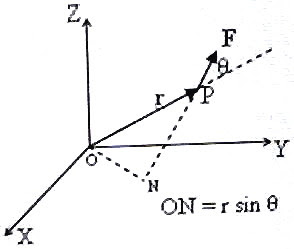
Therefore, Torque τ produced by the force F acting on the particle at P = ON × F.

Since ON = r sinθ where θ is the angle between r and F,

τ = rF sinθ

[Note that torque (τ) is a vector which is the vector product of the position vector r and the force vector F. Therefore, torque τ = r × F]

(4) A rigid body will be in mechanical equilibrium, if the total force and the total torque on the body are zero. The condition of zero net force will ensure that there is no change in the linear momentum and the condition of zero net torque will ensure that there is no change in the angular momentum.

For AP Physics C Examination, you will require the following also (in addition to the above):

(5) Consider a particle of mass m and linear momentum p. If the position vector of the particle is r, the angular momentum L of the particle with respect to the origin is given by

L = r × p

L is a vector whose magnitude is rpsinθ where r is the distance of the particle from the origin, p is the magnitude of the linear momentum vector p and θ is the angle between the vectors r and p.

Angular momentum is the moment of the linear momentum and is the product of linear momentum and the lever arm r sinθ. [By lever arm we mean the perpendicular distance of the line of action of the linear momentum from the origin].

(6) Moment of inertia (I)of a system of particles (as in the case of a rigid body) about an axis (of rotation) is given by

I = ∑mr2 where m is the mass of a particle at perpendicular distance r from the axis of rotation and the summation is for all the particles.

Radius of gyration (k) is related to moment of inertia (I) and the mass of the body (M) as

I = Mk2

Note that both I and k depend on the axis of rotation.

Parallel axes theorem states that the moment of inertia (I)of a body about any axis is equal to the sum of the moment of inertia (ICM )of the body about a parallel axis through its centre of mass and the product Ma2 where M is the mass of the body and a is the distance between the two axes:

I = ICM + Ma2

Perprndicular axes theorem states that the moment of inertia of a lamina about an axis perpendicular to its plane is equal to the sum of its moments of inertia about two perpendicular axes concurrent with the perpendicular axis and lying in the plane of the body.

[For example, if the X and Y axes are in the plane of the lamina, the Z-axis is the perpendicular axis and we have IZ = IX + IY where IZ, IX and IY are the moments of inertia about the Z, X and Y-axes respectively]

Moments of inertia of some regular bodies are given below:

(i) Thin circular ring (Mass M, Radius R) about its central axis perpendicular to its plane: MR2

A hollow cylinder (pipe) also has the above value for its moment of inertia about its own axis.

(ii) Thin circular ring (Mass M, Radius R) about any diameter: MR2/2

(iii) Thin rod (Mass M, Length L) about a perpendicular axis through the mid point: ML2/12

(iv) Circular disc (Mass M, Radius R) about its central axis perpendicular to its plane: MR2/2

(v) Circular disc (Mass M, Radius R) about its diameter: MR2/4

(vi) Solid cylinder (Mass M, Radius R) about the axis of the cylinder: MR2/2

(vii) Solid sphere (Mass M, Radius R) about its diameter: (2/5)MR2

(viii) Hollow sphere (Mass M, Radius R) about its diameter: (2/3)MR2

(7) Angular momentum (L) is given by

L = Iω where I is the moment of inertial about the axis of rotation and ω is the angular velocity.

This is similar to the expression for linear momentum p = mv. In angular motion (rotational motion) I is to be used in place of m and ω is to be used in place of v.

Newton’s 2nd law in rotational motion is

τ = dL/dt = d()/dt

If the moment of inertia (I) is constant, as is the case of a rigid body rotating about a fixed axis, we can write

τ = I (dω/dt) = I α where α is the angular acceleration.


The law of conservation of angular momentum states that in the absence of external torque, the angular momentum of a system remains unchanged. This can be expressed as

I1 ω1 = I2 ω2 where I1 and I2 are the initial and final moments of inertia and ω1 and ω2 are the initial and final angular velocities of a system in the absence of external torques.

(8) Acceleration (a) of a body rolling down an inclined plane of inclination θ is given by

a = gsinθ / [1 + (k2/R2)] where R is the radius of the body and k is the radius of gyration about the axis of rolling.

Since Mk2 = (2/5)MR2 for a solid sphere, k2/R2 = 2/5. This is the least value in the case of regular bodies and hence the acceleration a is maximum in the case of a solid sphere. In contrast, in the case of a ring (and pipe), the value of k2/R2 is 1 and is the maximum in the case of regular bodies and hence the acceleration a is the minimum in the case of a ring.

If differently shaped bodies are allowed to roll down from the top of an inclined plane, the solid sphere will reach the bottom first and the ring (and the pipe) will arrive last. It is interesting to note that for a given shape, the time of arrival at the bottom is independent of mas and size.

The above equation for acceleration down the plane can also be written as

a = (Mgsinθ) / [M + (I/R2)] where M is the mass of the body; but it will be better to remember the above form in terms of the radius of gyration, k.

(9) Rotational kinetic energy (K) of a body is given by

K = (½) 2

(10) A rolling body has translational and rotational kinetic energies. The total kinetic energy of a rolling body is therefore given by

K = (½) Mv2 + (½) 2 where v is the linear velocity of the body

(11) Work (dW) done by a torque τ in producing an angular displacement dθ is given by

dW = τ dθ [By dW we mean the small amount of work done for a small angular displacement dθ]

This is similar to the expression for work, dW = Fds in linear motion.

(12) Power (P) in rotational motion is given by

P = τω

This is similar to the expression for power, P = Fv in linear motion

Different quantities in linear motion and the corresponding quantities in rotational motion (about a fixed axis) are given below:

(a) Displacement x Angular displacement θ

(b) Velocity v = dx/dt or dr/dt Angular velocity ω = dθ/dt

(c) Acceleration a = dv/dt Angular acceleration α = dω/dt

(d) Mass M Moment of inertia I

(e) Linear momentum p = Mv Angular momentum L = Iω

(f) Force F = Ma Torque τ = I α

(g) Work dW = Fds Work dW = τ dθ

(h) Kinetic energy K = Mv2/2 Kinetic energy K = Iω2/2

(i) Power P = F v Power P = τω

In the next post, we will discus typical questions in this section.

Monday, January 14, 2008

AP Physics B- Answer to Free Response Question on Interference

In the post dated 13th January 2008, the following free response question for practice was given to you:

Your teacher suggests to you that an interference method could be used to measure the frequency of the sound emitted by two small identical speakers S1 and S2 arranged horizontally with a separation of 0.8 m (or any suitable distance) as shown. The speakers are connected in series to a sine wave generator of constant output frequency. Your teacher moves the probe (microphone) of a sound level meter along the horizontal line AB parallel to the line S1 S2 and demonstrates to you that at O, equidistant from S1 and S2, the intensity of sound is maximum and it varies between maximum and minimum when the probe is moved along OA and OB.

(a) Explain briefly what measurements you will make to enable you to calculate the frequency of the sound emitted by the speakers.

(b) If the distance between the speakers is increased, what quantity you measure is affected and how?

(c) What equations you will use for calculating the frequency? Explain the reason for your answer to (b) based on the relevant equation.

(d) If the distance between the 2nd maximum on one side of O and the 3rd maximum on the other side of O is 1.725 m, calculate the frequency of the sound emitted by the speakers, assuming that the speed of sound at the laboratory temperature is 345 ms–1.

(e) Your teacher asks you to reverse the connection to the terminals of one of the speakers. What change, if any, will this produce in the location of the maxima and minima? Your teacher suggests to you that an interference method could be used to measure the frequency of the sound emitted by two small identical speakers S1 and S2 arranged horizontally with a separation of 0.8 m (or any suitable distance) as shown. The speakers are connected in series to a sine wave generator of constant output frequency. Your teacher moves the probe (microphone) of a sound level meter along the horizontal line AB parallel to the line S1 S2 and demonstrates to you that at O, equidistant from S1 and S2, the intensity of sound is maximum and it varies between maximum and minimum when the probe is moved along OA and OB.

(a) Explain briefly what measurements you will make to enable you to calculate the frequency of the the sound emitted by the speakers.

(b) If the distance between the speakers is increased, what quantity you measure is affected and how?

(c) What equations you will use for calculating the frequency? Explain the reason for your answer to (b) based on the relevant equation.

(d) If the distance between the 2nd maximum on one side of O and the 3rd maximum on the other side of O is 1.725 m, calculate the frequency of the sound emitted by the speakers, assuming that the speed of sound at the laboratory temperature is 345 ms–1.

(e) Your teacher asks you to reverse the connection to the terminals of one of the speakers. What change, if any, will this produce in the location of the maxima and minima? Give reason for your answer.

As promised, I give below the answer:

(a) The mean width (β) of of the interference bands is required and therefore, the distance between the centres of the nth maxima on either side of the central point O is to be measured. This distance (xn) will give the width of n bands since the point O is the centre of the zero order maximum. The value of n should be such that the line joining S1S2 to the centre of the nth band is not much different from 90º.

The distance (d) between the speakers (coherent sources) and the distance (D) between the line AB and the line S1S2 also are to be measured to facilitate the calculation of the wave length of sound.

(b) If the distance between the speakers is increased, the interference band width is decreased.

(c) The equation for band width is β = λD/d where β is the band width given by β = xn/n, λ is the wave length of the sound produced by the speakers, D is the distance between the centre of the line S1S2 and the point O and d is the separation between the speakers.

From the above equation, λ = βd/D.

The frequency f of the sound can be calculated using the equation

f = v/λ where ‘v’ is the velocity of sound.

Since the fringe width β = λD/d, when the separation between the speakers (d) is increased, β must be decreased as stated in (b).

(d) The distance between the 2rd maximum on one side of O and the third maximum on the other side of O is 1.725 m. Evidently this is the width of 5 bands since the point O is the centre of the zero order maximum. Therefore,

β = xn/n = 1.725/5 = 0.345 m so that

λ = βd/D = (0.345×0.8)/6 = 0.046 m and

f = v/λ = 345/0.046 = 7500 Hz.

(e) When the connection to the terminals of one of the speakers is reversed, the phase difference between the sound waves emitted by the speakers becomes 180º. (Earlier, they were in phase and that was why maximum intensity was observed at O). The waves therefore arrive at O with a phase difference of 180º and they interfere destructively, producing minimum intensity at O. Similarly, the intensity will be minimum at all points where it was maximum earlier. In regions where the waves arrived with opposite phase (with phase difference equal to an odd multiple of π) earlier will now become regions of maximum intensity since the waves will reach those regions in phase (with phase difference equal to an even multiple of π). Therefore, the positions of maximum intensity and minimum intensity will get interchanged.

Sunday, January 13, 2008

AP Physics B- Free Response Question (for practice) on Interference

Let us discuss a free-response question of the type you can expect in the section ‘interference’.

At the moment I just give you the question for you to try yourself. (I’ll give you the answer in the next post). Here is the question:

Your teacher suggests to you that an interference method could be used to measure the frequency of the sound emitted by two small identical speakers S1 and S2 arranged horizontally with a separation of 0.8 m (or any suitable distance) as shown. The speakers are connected in series to a sine wave generator of constant output frequency. Your teacher moves the probe (microphone) of a sound level meter along the horizontal line AB parallel to the line S1 S2 and demonstrates to you that at O, equidistant from S1 and S2, the intensity of sound is maximum and it varies between maximum and minimum when the probe is moved along OA and OB.

(a) Explain briefly what measurements you will make to enable you to calculate the frequency of the sound emitted by the speakers.

(b) If the distance between the speakers is increased, what quantity you measure is affected and how?

(c) What equations you will use for calculating the frequency? Explain the reason for your answer to (b) based on the relevant equation.

(d) If the distance between the 2nd maximum on one side of O and the 3rd maximum on the other side of O is 1.725 m, calculate the frequency of the sound emitted by the speakers, assuming that the speed of sound at the laboratory temperature is 345 ms–1.

(e) Your teacher asks you to reverse the connection to the terminals of one of the speakers. What change, if any, will this produce in the location of the maxima and minima? Give reason for your answer.

Try to answer the above question which carries 15 points. I’ll be back with the answer shortly.

Friday, January 11, 2008

AP Physics B- Multiple Choice Questions on Interference and Diffraction

In the post dated 6th January 2008, the essentials of wave optics required for you to work out multiple choice questions were discussed. (You will find that post by clicking on the label ‘wave optics’ below this post). In that post, the following question was given for your practice:

A student prepared a Young’s double slit by drawing two parallel lines (with a separation less than a millimeter) on a smoked glass plate. [For smoking, the plate was held above the flame of a kerosene lamp]. Accidentally he used two different pins to draw the lines so that the widths of the slits (regions from where smoke was removed by the pin) were in the ratio 4:1. What will be the ratio of the intensity at the interference maximum to that at the interference minimum?

(a) 4

(b) 2

(c) 3

(d) 6

(e) 9

As promised, I give the solution here:

The ratio of intensities of light proceeding from the slits, I1: I2 = 4 : 1

Therefore, the ratio of amplitudes of light proceeding from the slits,

a1:a2 = √I1: √I2 = 2:1

The amplitudes at the maximum and minimum of the interference pattern are therefore in the ratio (a1+a2) : (a1a2) = 3:1

The intensities at the maximum and the minimum are in the ratio32:12 = 9:1 [Option (e)].

[The intensity is proportional to the square of the amplitude].

We will discuss a few more typical multiple choice questions in this section:

(1) A single slit diffraction pattern is obtained on a screen using yellow light. If the yellow light is replaced by blue light without making any other changes in the experimental set up, what will happen to the diffraction bands?

(a) Bands will disappear

(b) Bands will become broader and farther apart

(c) Bands will become broader and crowded together

(d) Bands will become narrower and farther apart

(e) Bands will become narrower and crowded together

The angular width of the central maximum is 2λ/a and the minima are located at θ = ± λ/a, ± 2λ/a, ± 3λ/a…etc.

This shows that when the wave length is decreased as is the case when blue light is used instead of yellow light, the bands will become narrower and crowded together [Option (e)].

(2) If white light is used in Young’s double slit experiment, what will happen to the interference bands?

(a) No bands will be obtained

(b) Many bands will be obtained as in the case of monochromatic light, but they will be coloured except the centre of the central band which will be white

(c) Very few bands will be obtained, but they will be coloured except the centre of the central band which will be white

(d) Many bands will be obtained as in the case of monochromatic light, but all of them will be white

(e) Very few bands will be obtained, but all of them will be white.

The centre of the central bright band (n = 0) will be white since all colours will satisfy the condition of zero path difference (and therefore of brightness). Since the condition for the first (order n =1) bright band is satisfied, at the point nearest to the centre, by the shortest wave length (violet), the first bright band will be coloured with the edge nearest to the centre violet and the edge farthest to the centre red. The remaining bright bands also will be coloured likewise. There will be very few distinct bands since the same point on the screen will satisfy the condition for brightness for one wave length and the condition for darkness for another.

The correct option therefore is (c).

(3) In an arrangement for Young’s double slit experiment, the separation between the slits is 1 mm. It is found that 8 bands of the double slit interference pattern can occupy the central maximum of the single slit diffraction pattern produced by one of the slits. What is the wjdth of each slit?

(a) 0.2 mm

(b) 0.25 mm

(c) 0.3 mm

(d) 0.35 mm

(e) 0.4 mm

The angular fringe width in the case of the double slit interference pattern is λ/d so that the total angular separation of 8 interference bands is 8λ/d. Since the angular width of the central maximum in the case of the single slit diffraction pattern is 2λ/a, we have

8λ/d = 2λ/a.

Putting d = 1 mm, a = d/4 = 0.25 mm.

[You should note that in Young’s double slit experiment, the pattern you see on the screen is actually a superposition of single-slit diffraction from each slit, and the double-slit interference pattern. Therefore, there will be a broader diffraction peak in which several fringes of smaller width due to double-slit interference appear. The angular width of a double slit intetrference fringe is λ/d where as the angular width of the central maximum due to the single slit diffraction is 2λ/a. Therefore, the number of interference fringes occurring in the broad central diffraction maximum depends on the ratio d/a, that is the ratio of the distance between the two slits to the width of a slit. If ‘a’ is very small, the diffraction pattern will become very flat and we will observe the two-slit interference pattern with an appreciable number of interference maxima of almost equal intensity in the central region].

You will find some useful multiple choice questions in this section at physicsplus: Multiple Choice Questions on Wave Optics.